It happens to almost everyone sooner or later. You turn the key and nothing happens, a tire goes flat on the way to work or the engine cuts out in the middle of traffic. In that moment it is easy to panic, and the first few minutes matter. What you do right away affects your safety, how fast you can get help and how much of your day the problem takes. This guide walks through what to do first when your car breaks down in Orlando: how to get to safety, how to figure out what kind of problem you have, what to try if it is something simple such as a dead battery or a flat tire, when to stop and call for help, what information to have ready and how a mobile mechanic can come to you. It does not promise any particular arrival time, since response times depend on the day, the location and how busy the technicians are, so ask when you call.
Step One: Get Safe
Before anything else, think about safety. Your car can be repaired, but you cannot be replaced.
- Stay calm. Take a breath. Most breakdowns are manageable if you take them one step at a time.
- Turn on your hazard lights as soon as you notice a problem, so other drivers see you.
- Steer to the safest place you can. If the car is still moving, try to coast to the shoulder, a parking lot or a side street. Move out of the travel lanes if you can.
- If you lose power steering or brake assist, the wheel and pedal can feel heavy. Keep both hands on the wheel, press the brake firmly and steer smoothly.
- Stop on level, firm ground when possible, away from curves and hills where other drivers cannot see you.
- Put the car in park, or in gear with a manual, and set the parking brake.
- Turn off the engine, unless you need it for something specific.
- Decide whether to stay in the car or get out. On a busy road, with fast traffic, it is often safer to stay in the car with your seat belt on and your hazards flashing. If you are in a safe spot away from traffic, or if the car is unsafe to stay in, get out on the side away from traffic and move to a safe place.
Do not stand between your car and traffic, and do not try to repair something on a busy road. If you feel unsafe for any reason, call emergency services.
Step Two: Notice What Happened
A few details about what just happened will help you decide what to do and help a technician later. If you can do so safely, note the following.
- What happened right before. Did the engine sputter, stall suddenly, overheat, make a noise or lose power?
- What the car does now. Does it turn over, click, make no sound at all or run and then die?
- Warning lights. Look at the dashboard and note which lights are on.
- The temperature gauge. Is it high?
- Smells and sights. Steam, smoke, a burning smell, a sweet coolant smell or fluid under the car.
- The fuel gauge. Make sure you have not simply run out of fuel.
- Recent events. A pothole, a curb, a refill or a recent repair.
Step Three: Match the Symptom to the Likely Cause
Different symptoms often point to different problems. These are general guides, and only an inspection can confirm the cause.
The car will not start, and you hear nothing or only a click
This often points to a dead or weak battery, or to loose or corroded battery connections. Dim lights and a clicking sound when you try to start are common signs. A jump start can sometimes get you going, but a battery that died once may need a test.
The engine cranks but will not start
When the engine turns over but does not catch, the cause may be fuel, spark, an air supply problem or a sensor issue. Check that you have fuel first.
The car stalls while driving
Stalling can come from the fuel system, the ignition, a sensor, the charging system or a battery that is not being charged. A battery warning light on the dash before the stall points to the charging system.
A flat tire or a pull to one side
A tire that has lost air can cause a pull, a thumping sound or a feeling that the car is leaning. If you suspect a tire problem, slow down gently and stop in a safe place. Do not keep driving on a flat tire, since it can destroy the tire and damage the wheel.
Overheating
A temperature warning light, steam or a gauge in the red means you should stop as soon as it is safe, shut the engine off and let it cool. Never open the radiator cap on a hot engine.
Smoke, burning smells or fluid leaks
These can point to many problems. Get away from the car if you see flames or heavy smoke, and call emergency services.
Brake or steering problems
If the brakes or steering do not feel right, stop driving, get to a safe place and call for help.
Step Four: Try Simple Fixes Only If It Is Safe
Some problems have simple fixes, but only try them if you are in a safe place, away from traffic, and you know what you are doing.
A dead battery
- Check that the battery cables are tight and not badly corroded.
- If you have jumper cables or a jump starter and a second vehicle or a charged jump starter, follow your owner’s manual for the right procedure. Connecting cables the wrong way can damage the electrical system.
- If the car starts, a technician should test the battery and charging system. A battery that went dead once may do it again.
A flat tire
- Only change a tire on firm, level ground, well away from traffic.
- Follow your owner’s manual for the jack points, the jack and the spare. Some vehicles have a temporary spare with limits on speed and distance, and some have a repair kit instead.
- If you are not comfortable changing it, or it is not safe, call for help.
Out of fuel
- If you have run out, you will need fuel. Do not try to carry fuel in anything but an approved container, and do not do it on a busy road.
If anything about it feels unsafe, call for help instead. A repair on a crowded roadside is not worth the risk.
Step Five: Call for Help
When you cannot fix it safely, call for help. Have this information ready.
- Your location. The street, the nearest cross street, a mile marker or a landmark. A map app on your phone can show your exact location.
- Your vehicle. Year, make, model and color.
- What happened. The symptoms you noticed, and any warning lights.
- Whether you are safe. Say if you are on a busy road, and whether anyone needs medical help.
- Your contact number.
- Any special needs. Passengers, children, pets or a time limit.
You can call roadside assistance if you have it, a tow service or a mobile mechanic. Which one is right depends on the problem. Our post on what to do when your car breaks down goes into more detail on the steps and the options.
What a Mobile Mechanic Can Often Handle at the Roadside
Many common breakdown problems can be handled where the car sits. Depending on the vehicle and the situation, a mobile mechanic may be able to help with the following.
- A dead battery. Test it, jump start the car and replace the battery if needed.
- A flat tire. Help with changing a tire or with a spare, depending on the situation.
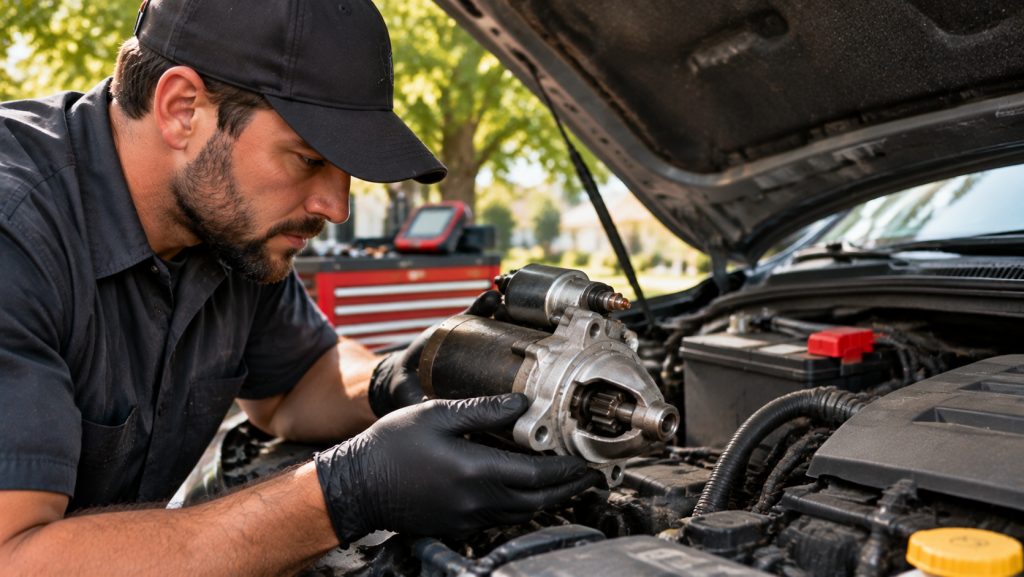
- Starting problems. Check the battery, connections, starter and fuel delivery to find out what is wrong.
- A check engine light and diagnostics. Read the codes and identify the cause.
- Belts, hoses and some cooling system problems.
- Some brake and other small repairs.
Some problems need a tow and a shop. Examples include major engine or transmission failures, serious overheating damage, big brake or suspension failures, accident damage and repairs that need a lift or specialized equipment. A good technician will tell you honestly whether the car can be fixed where it is or needs to go to a shop, and may be able to arrange or recommend the next step.
About Response Times
Everyone wants to know how fast help can arrive. The honest answer is that it depends. Distance, traffic, time of day, weather, how many calls are coming in and the type of job all play a part, and no one can promise a specific time for every situation. When you call, ask for an estimated arrival time and what to expect, and ask how to stay safe while you wait. If you are in danger, call emergency services first.
While You Wait
- Stay visible. Keep your hazard lights on. If it is safe, set out reflective triangles or flares.
- Stay in a safe place. Away from traffic, with your seat belt on if you stay in the car.
- Stay hydrated and cool. Florida heat adds up fast in a parked car. Open windows slightly if the air is stuffy, and drink water. If it is very hot, find shade in a safe place away from traffic.
- Keep your phone charged. A power bank or a car charger helps.
- Be careful with the engine. Do not run the engine in an enclosed space, and keep the exhaust clear.
- Do not accept help from strangers who approach you in an unsafe or unusual way. Wait for the person you called, and confirm who they are when they arrive.
- Stay in contact. Share your location with someone you trust.
Be Prepared Before It Happens
A little preparation can turn a breakdown from a crisis into an inconvenience.
- Keep a kit in the car. Include water, snacks, a phone charger, a flashlight, jumper cables or a jump starter, reflective triangles, a first aid kit and a tire pressure gauge.
- Know your spare. Check that it is inflated and that you have the jack and tools.
- Save numbers. Store your roadside assistance, insurance and a mobile mechanic’s number in your phone.
- Stay on top of maintenance. Many breakdowns come from worn batteries, tires, belts and fluids. Our guide on how often you should get a car tune up explains how regular service can help you avoid surprises, and your owner’s manual gives the schedule for your car.
- Do not ignore warning lights and new noises.
- Keep fuel above a quarter tank.
Stop Driving and Get Help If You Notice
- A brake warning light, a soft pedal or brakes that stop responding normally.
- Steam, a temperature warning or a burning smell.
- An oil pressure warning light.
- A flashing check engine light.
- Steering that suddenly feels loose or heavy.
- A flat or damaged tire, or a strong vibration.
- Any smell of fuel or exhaust fumes inside the cabin.
Pull over in a safe place as soon as you can and call for help. Your owner’s manual explains what each warning light means for your vehicle.
Quick Summary
- Get safe first: hazard lights, a safe spot, and a decision about staying in or leaving the car.
- Notice what happened and which warning lights are on.
- Try simple fixes, such as a jump start or a tire change, only if it is safe and you know how.
- Call for help with your location, vehicle details and symptoms ready.
- Ask for an estimated arrival time, since response times vary.
- Some problems can be fixed on the spot, while others need a tow and a shop.
- A kit in the car, saved numbers and regular maintenance make a breakdown easier.
No one plans for a breakdown, but a little knowledge makes it far less stressful. If you need help, visit the Orlando Rapid Mobile Mechanic homepage to learn more, or contact us to talk about your situation.